How to Organize Beads and Gemstones: A Storage System That Actually Works
By BENECREAT Craft Team · Published · Updated
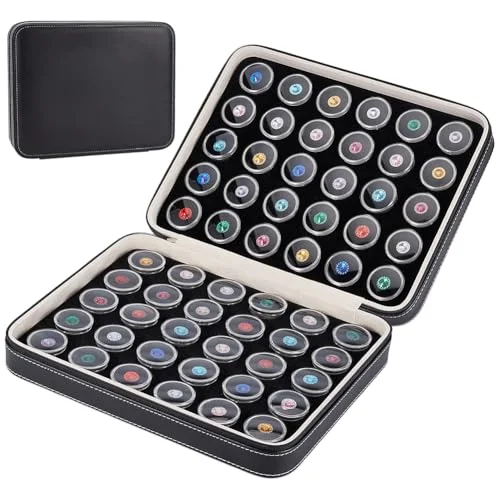
Organize beads the way you design: by color first, then size and shape, with seed beads in individual jars or tubes and larger beads in divided boxes. Store gemstones one to a slot, closed away from light, at moderate humidity. Clear containers with locking or screw-top lids do the rest.
Every bead-storage article says “find what works for you,” which is true and useless. This guide gives the decision rules instead: which sorting system fits which kind of beader, which container holds how many beads of which size, why some compartment boxes leak between cells, and the light, humidity, and hardness rules that gem collectors follow and bead guides skip.
Sort by Color, Size, or Project? Pick Your Design Habit
Three systems dominate, and each is right for a different maker.
| System | Who it suits | Why it works | Where it fails |
|---|---|---|---|
| Color first, then size | Designers who start from a palette | Matches how a design comes together on the mat; exposes duplicate purchases | Mixed-size color bins hide the size you need |
| Size first, then color | Pattern beaders and weavers | A pattern calls for 11/0 or 8/0; you go straight to the tier | Hard to browse for inspiration |
| Project kits | Kit sellers, class teachers, anyone with unfinished pieces | Everything for one design lives in one box or bag | Duplicates supplies across kits |
The common compromise is a split at about 4 mm. Seed beads, bugles, and anything under 4 mm live in individual screw-top tubes or small jars sorted by size code and then color, because you pour a seed bead out rather than pick it up. Beads over 4 mm, pearls, gemstone strands, and findings live in divided boxes, with a zip bag inside each compartment so a whole lot lifts out and nothing migrates. Separate the expensive lots from the cheap glass, both to protect them and because you reach for them differently. Then label at the moment a bead goes into a container, not later.
The Seed-Bead Size Scale (and Why It Runs Backwards)
Seed-bead sizes descend as the beads get bigger, an inheritance from the old “aughts” counting system, and Czech and Japanese beads of the same nominal size differ slightly. The working numbers:
| Size | Approx. diameter | Beads per inch | Beads per gram (approx.) |
|---|---|---|---|
| 15/0 | 1.3 to 1.5 mm | 25 | 290 |
| 11/0 | 2.0 to 2.2 mm | 17 | 110 |
| 11/0 cylinder (Delica) | 1.6 mm | 190 | |
| 8/0 | 3.0 to 3.1 mm | 13 to 14 | 38 |
| 6/0 | 3.8 to 4.3 mm | 8 | 15 |
Beads-per-gram is the number that turns a container into a capacity, which brings us to the question no storage guide answers.
Which Container Holds How Many Beads?
Bead tubes are the one container with published capacities: a standard six-inch tube holds about 28 grams of 11/0 seed beads, around 3,000 beads, and shorter display-stand tubes about 21 grams. From that density, roughly 1.2 to 1.4 grams of 11/0 glass per milliliter of interior space, you can estimate anything else. Treat the figures below as estimates and calibrate with a kitchen scale.
| Container | Interior (approx.) | 11/0 seed beads | 8/0 | 6/0 |
|---|---|---|---|---|
| Six-inch bead tube | 20 to 22 mL | 3,000 (28 g) | 1,000 | 400 |
| BENECREAT gem jar, 1.2 by 0.6 in, 1 in inner diameter | 7 mL | About 1,000 (8 to 10 g) | About 350 | About 130 |
| BENECREAT flip box, 2.63 by 2 by 0.47 in | About 30 mL | 4,000 to 5,000 (35 to 45 g) | 1,300 to 1,700 | 500 to 650 |
| Drawer-cabinet drawer | 100 mL and up | A full 50-gram bag and more |
Read the table against your own habits. A palette beader who owns 20 to 50 grams of each color wants tubes or flip boxes; a sampler who owns a pinch of sixty colors wants small jars in a case, which is exactly what the 60-jar gemstone collection case turns out to be good for. A fuse-bead crafter with thousand-bead bags needs a small-parts drawer cabinet, not either.
Lids, Locks, and the Compartment-Box Leak
Every experienced beader has a spill story, and nearly all of them come down to the lid.
- Screw-top jars seal best and survive being knocked off a table. They are slower to open, which is the price of never spilling.
- Flip-top boxes and tubes open one-handed for fast access during a project. Look for a hinge that clicks shut and a lip that holds it.
- Snap-lock boxes are the compromise: two latches hold better than one, and a positive click tells you it is closed. Our 18-pack of snap-lock flip boxes uses two locks per box for exactly that reason, and the 0.47-inch profile stacks flat in a drawer.
- Compartment boxes leak between cells when the dividers do not meet the lid, so seed beads migrate the moment the box tilts. Check that the divider tops touch the underside of the closed lid, or keep a zip bag in each cell. Movable dividers fall out; fixed ones do not.
Whatever the lid, the container should be clear or the label should be. You are not sorting beads, you are making them findable.
Storing Gemstones and Crystals: Three Rules Bead Guides Skip
Loose stones and crystals have failure modes that glass beads do not, and a bead system that ignores them will fade, scratch, or craze a collection over time.
Light. Several popular stones lose color under ultraviolet light, which reverses the color centers that give them their hue. Amethyst fades from purple toward grey over months to years; rose quartz loses its pink; kunzite is extremely light-sensitive; fluorite and smoky quartz lighten; citrine loses depth. Ordinary indoor lamps emit some UV as well, so the protection is simple: store these stones in a closed, opaque case and rotate them off any lit display shelf.
Humidity and heat. Opal holds several percent water and can craze if it dries out; porous stones such as turquoise, pearl, amber, and lapis absorb moisture and oils; some minerals, including selenite and halite, degrade in damp air, and pyrite and hematite rust. A stable room temperature and moderate humidity, well under 65 percent, suits nearly everything, with a silica packet in the case for the porous stones, swapped every six months. The same threshold matters for beads: above about 65 percent relative humidity, mold can grow on thread and cord.
Hardness. Gems scratch each other. Quartz at Mohs 7 will scratch fluorite at 4 and selenite at 2, and ordinary household dust contains quartz, so anything softer than 7 can be marked simply by being stored dusty and loose. The fix is one stone per slot: individual jars, coin capsules for cabochons, or a grooved foam insert for faceted stones, and a zip bag inside a jar for chips and strands. The 60-jar case is built around that rule, with a removable memory-foam insert, sixty 32 by 17 mm screw-top jars, and a zip closure that keeps dust out of the whole set.
Labeling That Survives a Reorganization
Gem collectors label better than beaders, and their habit transfers. The minimum on any jar is the stone or bead name and size; collectors add weight, origin, price paid, and an inventory code such as “C2a” that points to a spreadsheet row, and they put the label on the bottom of the jar so it stays with the stone when the tray is rearranged. For beads, write the size code and color on the container and, if you resell or teach, the source and price, which turns the label into a reorder note. Label at the moment the bead goes in. Six months later, no one remembers which gold was the 11/0 and which was the 12/0.
Building the System in an Afternoon
- Measure the shelf or drawer the system has to fit before buying a single container.
- Pour everything out and sort into the two tiers: under 4 mm and over 4 mm.
- Within each tier, sort by size code, then by color; set the precious lots aside.
- Match each pile to a container size using the capacity table, leaving room to grow.
- Bag lots inside compartments, jar stones one to a slot, and label as you close each lid.
- Put the light-sensitive stones in the closed case and the silica packet in with the porous ones.
Then maintain it with one rule: beads go back the same day they come out. Our storage and display boxes and beading supplies cover the containers and the wire and cord that go in them.
Sources
Glass-bead conservation conditions are from the Canadian Conservation Institute; kunzite’s light sensitivity from the GIA buyer’s guide; collection-organizing and hardness-separation practice from the International Gem Society. Seed-bead dimensions, beads-per-gram figures, and tube capacities reflect published supplier charts; container capacities are volume estimates, and product dimensions come from current BENECREAT listings.
Reviewed by the BENECREAT Craft Team.
Frequently Asked Questions
What is the best way to organize beads?
Sort the way you design. Most beaders sort by color first, then by size and shape within each color, because that is how a design comes together on the mat. Seed beads go in individual tubes or jars so you can pour out just what you need; larger beads and findings go in divided boxes with a zip bag inside each cell so a whole lot lifts out at once. Keep pricier lots separate from cheap glass, label everything, and put beads back the same day.
What is the best bead organizer?
There is no single winner because the hobbies differ. Seed beaders favor screw-top or locking tubes and small jars in stands and cases, so a color is one container. Fuse-bead crafters need drawer cabinets or tackle boxes that hold a thousand beads per slot. Gem and crystal collectors use foam-insert cases with individual jars so stones never touch. The common thread is a clear container with a lid that locks or screws shut, in a size that matches how much of each item you own.
How do I organize beads by size?
Learn the seed-bead scale first, since the numbers run backwards: size 15/0 beads are about 1.5 mm, 11/0 about 2 mm, 8/0 about 3 mm, and 6/0 about 4 mm. Split your stash at roughly 4 mm: seed and bugle beads below it in tubes or jars, everything above it in divided boxes. Within each size, sort by color, and write the size code on every container, because an 11/0 and a 12/0 look identical until they refuse to pass the same needle.
How many size 11 seed beads fit in a small container?
Roughly 110 size 11/0 seed beads weigh a gram, and a standard six-inch bead tube holds about 28 grams, so around 3,000 beads. A 1.2 by 0.6 inch gem jar holds an estimated 8 to 10 grams, about 1,000 beads, and a 2.6 by 2 by 0.5 inch flip box about 35 to 45 grams, or 4,000 to 5,000 beads. Those are estimates from volume; weigh one full container on a kitchen scale to calibrate your own stash.
What are some DIY ideas for storing beads?
Recycled containers work when they seal: baby-food jars, spice bottles, mini mason jars, coin tubes, and the small clear boxes crayons come in for color-sorted stashes. Pill organizers hold jump rings and crimps, floss boxes hold findings, and a magnetic strip on the wall holds tins of small parts. Two rules make the DIY route succeed: the lid must lock or screw shut, and every container must be clear or clearly labeled.
How should you store loose gemstones and crystals?
Individually, in the dark, and dry. Keep each stone in its own jar or foam slot so harder stones never touch softer ones, since quartz will scratch anything softer than itself and even household dust is hard enough to mark soft stones. Store the case closed and out of direct sun, because amethyst, rose quartz, kunzite, fluorite, and smoky quartz fade under light. Aim for room temperature and moderate humidity, and add a silica packet for porous stones such as opal and turquoise.
Which crystals fade in sunlight?
Amethyst is the classic, fading from purple toward grey over months to years; rose quartz loses its pink, kunzite is extremely light-sensitive, fluorite and smoky quartz lighten, and citrine loses depth. The mechanism is ultraviolet light reversing the color centers that give these stones their hue, and ordinary lamps emit some UV too. Closed, opaque storage protects them completely; a windowsill display is a slow bleach.
Can beads and gemstones be stored together?
In the same case, yes; in the same compartment, no. Glass beads are not light-sensitive and tolerate most conditions, so they can share a system with stones, but each gemstone needs its own jar or slot so it cannot rub against harder neighbors. Keep the humidity moderate for both: above about 65 percent relative humidity, mold can grow on bead thread and cord, and porous stones absorb moisture.
Sixty jars, one zip, zero spills
BENECREAT 60-piece gemstone collection case: sixty 1.2 by 0.6 inch screw-top jars in a zip-closed box with removable foam, sized for loose stones, crystals, and a full seed-bead palette.
See the 60-jar case