Crimp Beads vs Crimp Tubes vs Clamshell Bead Tips: Sizes, Pliers, and How to Use Each
By BENECREAT Craft Team · Published · Updated
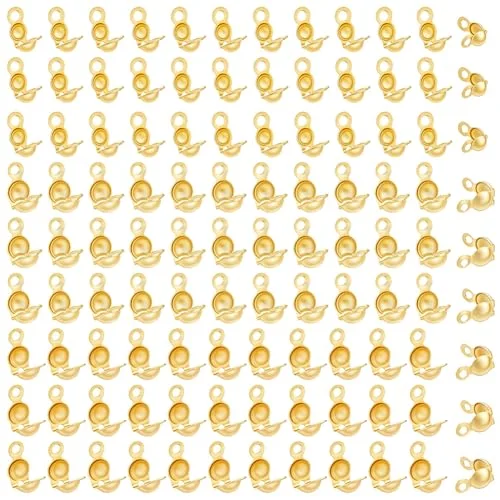
For wire-strung jewelry, use a 2 by 2 mm crimp tube folded with crimping pliers, with a wire guardian at the clasp. Crimp beads are the rounder, cheaper, weaker version of the same idea. Clamshell bead tips are for knotted cord, not for wire. Never put a crimp on elastic, fishing line, or thread.
That is the consensus of the makers who answer beginner questions on r/Beading, r/jewelrymaking, and r/braceletcraft, and it matches what Beadalon, Soft Flex, and Fire Mountain Gems publish. We read 30 threads, pulled the dimensions from Beadalon’s findings catalog and Soft Flex’s crimp guide, and built the one thing no ranking page has: a single table that crosswalks Beadalon’s size numbers, millimeter sizes, wire diameters, pliers, and covers. BENECREAT makes clamshell bead tips and a beading-wire starter kit; both appear where they honestly fit, and the crimp picks are Beadalon, The Beadsmith, and Adabele. No brand paid for placement.
Three Findings, Three Jobs
| Finding | What it is | Use it on | Never on | Closed with |
|---|---|---|---|---|
| Crimp tube | Short seamless metal tube, 1 to 3 mm | Flexible beading wire | Thread, elastic, monofilament | Crimping pliers, two steps |
| Crimp bead | Round hollow bead with a seam | Flexible beading wire, light pieces | Thread, elastic, monofilament | Crimping pliers, two steps |
| Clamshell bead tip | Hinged cup with a bottom hole and a hook or loop | Knotted silk, nylon, waxed linen | Beading wire, as the only finish | Fingers or chain-nose, gently |
The reason the first two are wire-only is mechanical. A crimp grips by pressing metal into the nylon coating of a stainless cable. Thread is too thin for it to grip, elastic and monofilament get cut by its edges, and Fire Mountain’s expert says the same about silk: the metal wears through it. The most upvoted answer in a 2026 r/Beading thread on the subject put it in one line: crimp beads “are designed for use with flexible beading wire only. They don’t hold beading threads at all because the threads are too thin. They cut elastic cord, nylon cord, or monofilament.”
What Makers Actually Agree On
- Tubes over beads. Every manufacturer guide gives the same physical reason: more metal in contact with the wire and no seam. Soft Flex: “The hidden seam is the real reason so many cheaply made crimps fail.” A r/Beading regular who has crimped for decades: “If you can get crimp tubes instead of beads they give an even better finish.”
- Fold, do not flatten. In a 32-point thread asking whether flat crimps fail, the top reply at 39 points was that flat crimps “look like children made them” and “don’t hold as well as properly made folded crimps.” Another at 15: “A flat crimp is only half complete.” The dissent exists, a six-point comment calling crimping pliers worse than covers, and we note it, but it is outvoted five to one.
- Size for the wire, wires parallel, moderate squeeze. Twice the wire diameter plus a little is the inside diameter you need. The two wires must lie side by side inside the tube; crossed wires make the fold fail. And Soft Flex’s rule on pressure is the one everyone repeats: “Never smash your crimp harder than you would shake your grandmother’s hand.”
- Kit crimps are for practice. “Use those round beads that come in your finding kits as spacers or for practice. They tend to be made out of low quality metal and may have a plating that chips off when you crimp them.” That includes the crimps in our own starter kit, and we say so below.
- Wire guardians are not optional for pieces you sell. “Wire guards are a must as I’ve had necklaces come apart without them,” from an 11-point reply. The guardian is a horseshoe that sits inside the clasp loop so metal never rubs the wire’s coating.
- Crimp covers are cosmetic. “Crimp covers are merely decorative and do nothing to hold the necklace together.” Use them for looks over a good fold, never instead of one.
- Clamshells belong on cord. The makers who use them for pearl knotting like them; the makers who tried them on wire report shells breaking and hinges fatiguing. “Reopening a clamshell bead tip could make the hinge break from fatigue, so you might want to have a couple of extra.”
The Size Table: Beadalon Numbers, Millimeters, Wire, Pliers, and Covers
Beadalon numbers its crimps 0 through 4; Soft Flex and most Amazon listings use millimeters. Nobody publishes both side by side, so here they are, with Beadalon’s inside and outside diameters from its findings catalog.
| Beadalon size | Crimp tube (ID × OD × length) | Crimp bead (ID × OD) | Market name | Beading wire it fits | Pliers | Cover |
|---|---|---|---|---|---|---|
| 0 | 0.8 × 1.3 mm | .010 to .013 in | Micro | 3 mm | ||
| 1 | 0.8 × 1.3 × 1.2 mm | 1.3 × 2.0 mm | 1 by 1 mm | tube: .010 to .013 in; bead: .010 to .021 in | Micro (tube), Standard (bead) | 3 mm |
| 2 | 1.3 × 1.8 × 2.0 mm | 1.5 × 2.5 mm | 2 by 2 mm | tube: .013 to .024 in; bead: .024 to .026 in | Standard | 3 mm |
| 3 | 1.5 × 2.0 × 2.0 mm | 1.8 × 3.0 mm | 2 by 2 or 2 by 3 mm | tube: .024 to .026 in; bead: .024 to .036 in | Standard (tube), Mighty (bead) | 3 or 4 mm |
| 4 | 2.0 × 2.5 × 3.0 mm | 3 by 3 mm class | .026 to .036 in | Mighty | 4 mm |
Read it by wire. The everyday .015 to .021 inch wires, which cover 2 mm to 8 mm beads, take a size 2 tube and a standard crimper. Fine .010 to .013 inch wire for seed beads and pearls takes a size 1 tube and a micro crimper. Heavy .024 inch wire for large stone takes a size 3 tube or a 2 by 3 mm; .030 and up takes size 4 and the mighty crimper. Soft Flex’s version of the same guidance: 1 by 1 mm for .010, 2 by 2 mm for .014 and .019, 2 by 2 or 2 by 3 mm for .024.
Two refinements from Fire Mountain’s crimp chart. The minimum inside diameter for a single pass of wire is 0.76 mm at .015 inch, 0.97 mm at .019, and 1.22 mm at .024, and you need roughly double that for the normal two passes. And among tubes of the same outside size, a smaller hole means a thicker wall and a stronger hold: a 2 by 2 mm sterling tube with a 1 mm hole has more metal in it than one with a 1.3 mm hole.
The wire itself is chosen first: use the thickest wire that passes through the beads, and pick a 19- or 49-strand cable for anything you will wear.
Which Metal
The trade-off is real, so both sides are here. Sterling silver and gold-filled tubes are softer and thicker-walled, which is why the most experienced makers in the threads use them for everything they sell: “2x3mm crimp tubes in precious metal because they are softer and mold around the wire for a better hold.” Soft Flex makes the same case and warns that hard base metal “can be harmful to your stringing material.”
Plated brass tubes from a named brand are what most hobbyists use, and the makers who use them report no failures when the crimps are good quality; plated is also the answer for a nickel allergy. Stainless tubes exist and hold, but no manufacturer guide recommends them for standard crimping pliers, so expect to squeeze harder. The one metal everyone rejects is the unnamed kit crimp: thin, seamed, and plated in a layer that chips when it is folded.
How to Crimp a Tube, Step by Step
This is Beadalon’s and Soft Flex’s method, which are the same method.
- Size the crimp from the table above and pick the matching crimper. A standard crimper has two stations: the rear notch with a tooth, and the front round hole.
- String the crimp tube, then a wire guardian, then the clasp, and bring the wire back through the tube. Leave about a quarter inch of tail.
- Straighten the two wires inside the tube so they lie side by side, not crossed. If they cross, the fold will fail.
- Crease in the rear notch: one firm squeeze puts a dent down the middle so the crimp looks like a crescent, with one wire on each side of the dent.
- Fold in the front hole: turn the crimp on its side, squeeze, and the crescent closes into a small rounded cylinder. Soft Flex has you rotate and squeeze again to round it.
- Do not over-squeeze. A firm handshake, not a death grip. Crushing work-hardens the crimp and makes it brittle.
- Tug it. Pull hard on the clasp. If the wire slides, cut the crimp off and start again; if it holds, trim the tail flush against the crimp.
- Leave slack in the strand. Beads take more room around a wrist or neck than in a straight line, so a strand strung tight puts the whole load on the crimp with every wear.
One maker’s variation is worth knowing: after the fold, a light squeeze with chain-nose pliers turns the crimp into a small flat rectangle with the wires sealed inside, and it hides under a 3 mm cover.
How to Use a Clamshell Bead Tip
For knotted cord: silk, nylon, or waxed linen, which is where every source we read puts clamshells.
- Tie a knot at the end of the cord, or knot around a small seed bead so the knot cannot pull through.
- Thread the cord through the hole in the bottom of the open clamshell and pull the knot down into the cup.
- Put a drop of glue such as G-S Hypo Cement on the knot and trim the tail.
- Close the two halves over the knot with your fingers or the tips of chain-nose pliers, gently; the hinge is the weak point and squeezing hard marks the shell.
- Curl the hook closed around a jump ring with round-nose pliers, or use the closed-loop style, which Artbeads calls durable enough for bracelets as well as necklaces.
There is a wire method too. Beadalon’s own blog shows a size 11 seed bead and a size 1 crimp tube crimped inside a clamshell on .015 inch 49-strand wire, for light beads, and several makers describe the same hybrid. It works for a delicate piece and hides the crimp entirely. It is not a substitute for a proper crimp and guardian on a strand of stone.
Crimp Covers: When They Earn a Place
A cover is a slotted hollow bead that closes over the finished crimp so the end of the strand looks like one more bead. Fire Mountain’s sizing: 3 mm covers “work well at covering most 1x1mm-2x3mm crimps,” and 4 mm covers when the design has 4 mm metal beads, so the cover matches. Beadalon’s 3 mm cover has a 0.91 mm slot, the 4 mm a 1.09 mm slot. Close a cover with the front hole of the crimper or with any smooth-jaw pliers.
The consensus is that they add nothing to strength and are worth using only when a bare crimp would look wrong next to metal beads. Makers on both sides of the debate agree that a cover cannot rescue a bad crimp, and a large cover can look more awkward than the crimp it hides.
Why Crimps Fail
Eight causes, each named by a manufacturer or a maker who fixes other people’s jewelry.
- Crimp too large for the wire. It cannot grip; the wires slide out. The commonest cause, and the reason for the size table.
- Crimp too small. The wires cannot separate, so the crease lands on both and the fold is weak.
- Wires crossed inside the tube. The U never forms correctly.
- Flattened instead of folded. Half the grip, sharp edges, and the repair benches’ number one complaint.
- Over-squeezed. Work-hardened metal cracks at the fold.
- Under-squeezed. A shallow crease that opens under load.
- Cheap crimps. Seamed, thin, or plated in a layer that chips; the ones a maker described as sliding off the wire “like they were teflon coated.”
- Wrong material or no slack. Crimps on fishing line, elastic, or thread; or a strand strung with no play, breaking at the crimp every time.
A wire guardian at each end prevents a ninth: the clasp loop sawing through the wire’s coating over months of wear.
The Picks
1. Crimp tubes, everyday: Beadalon size 2
The 2 by 2 mm tube is the standard finish for the wires most people string with, and Beadalon’s is the one whose dimensions are published: 1.3 mm inside, 1.8 mm outside, 2 mm long, silver plated. The 46-piece pack covers a first season; the 600-piece variety pack is the production size, and Beadalon’s assorted sizes 1 through 4 is the right first buy if you have not settled on a wire yet.

The Beadsmith’s 2 by 2 mm tubes, 500 pieces, are the other named-brand option at the same size. Neither is precious metal; both are plated base metal from brands whose crimps makers use without complaint.
2. Crimp tubes, precious metal: Adabele sterling
For pieces you sell or wear daily, the makers who have repaired the most jewelry use sterling or gold-filled tubes, because the softer metal folds around the wire instead of fighting it. Adabele’s 2 mm sterling tubes are the widely stocked option; note the 1.5 mm hole, which by Fire Mountain’s wall rule is a thinner-walled tube than a sterling 2 by 2 with a 1 mm hole, so it grips best on .019 to .024 inch wire. The 1.6 mm tiny tubes, with a 0.9 mm hole, are the sterling answer for .010 to .013 inch wire and a micro crimper.

3. Crimping pliers: Beadalon Standard
Two stations, one firm squeeze each. The Beadalon Standard crimper closes size 1 and 2 crimp beads and size 2 tubes, which is every crimp in the everyday wire range, and Beadalon’s three-step method is designed around it. The Beadsmith’s crimping pliers, for 2 mm crimps and .013 to .024 inch wire, are the equivalent from the other mid-range brand.

Outside that range you need the other sizes: the Beadalon Micro crimper or Beadsmith Micro for 1 by 1 mm tubes on fine wire, and the Beadalon Mighty for size 3 beads and size 3 and 4 tubes on heavy strands. If you already know you will string everything from pearls to lava, Beadalon’s 4-piece set covers all three.
4. The one-size shortcut: Beadsmith Magical Crimp Forming Pliers
The Magical Crimp Forming Pliers turn a 2 mm crimp tube into a round bead in one station, and with the matching 2 by 2 mm tubes the result looks like a finished metal bead with no cover. The limits are narrow and published: 2 by 2 mm tubes only, and .018 to .020 inch wire on the Beadsmith listing, .019 and .024 in Soft Flex’s version. The caveat from the maker who has crimped since 2000: “The magical one makes it really easy to cross wires.” Hold the wires apart as you close it, and keep a standard crimper for every other size.

5. Wire guardians: Beadalon
A wire guardian is a tiny horseshoe with a channel that carries the wire around the inside of the clasp loop, so the loop rubs metal, not nylon. Beadalon’s are the sized ones: size 1 with a 0.56 mm hole for wire to .021 inch, size 2 with a 0.69 mm hole for .024 and .026. The 144-piece silver-color pack lasts a long time. Budget alternatives in plated brass, such as Beebeecraft’s 300-piece box or PandaHall’s six-color pack, do the same job for light pieces. Nothing is sold for .030 inch and up; those strands get a larger clasp loop and a thicker wire.

6. Crimp covers: The Beadsmith 3 mm
If you want covers, buy them to match the crimp: The Beadsmith’s 3 mm silver-plated covers fit over 2 by 2 and 2 by 3 mm crimps, Beadalon’s 4 mm match 4 mm metal beads, and Beebeecraft’s gold-plated 3 mm suit gold-tone designs. Close them with the front hole of the crimper. They hide; they do not hold.

7. Clamshell bead tips: BENECREAT, for knotted cord
This is our product, and it belongs in the cord section, not the wire section. BENECREAT’s clamshell bead tips come 150 to a box in three sizes, with bottom holes of 1.0 and 1.6 mm and a 3 mm cup, in 18K gold plating over brass. The 1 mm hole suits standard silk and nylon knotting cord with a knot in the cup; the 1.6 mm hole takes heavier waxed linen or a doubled cord. Close them gently, keep spares for the hinge, and glue the knot.

The honest limits: they are plated brass, not sterling, and we have no data on how the plating wears, so we do not claim any. They are not a finish for beading wire on their own; if you want the hidden-crimp look on wire, use the seed-bead-and-tube method above. The Beebeecraft 200-piece box is the same tier from another brand; Syhood’s 1,400-piece assortment is the volume option for kids’ and craft-fair work.
About Starter Kits, Including Ours
Kits that bundle wire, jump rings, clasps, and a bag of round crimps sell in the thousands, and ours is one of them: the BENECREAT beading wire kit pairs 240 feet of .015 inch 7-strand wire with 50 round crimp beads of 1.5 mm, 100 jump rings, and 30 lobster clasps. It is a fair way to learn the motion. It is also exactly the kind of kit the makers above describe: the round crimps are kit-grade and at the small end for two passes of .015 wire, and 7-strand is the stiffest grade of beading wire. Use it to practice, then move to size 2 tubes, a standard crimper, wire guardians, and a 19- or 49-strand wire for anything you will wear or sell. We would rather say that than have you string a gift on the practice kit.
Where BENECREAT Stands
One product of ours is a real pick here, the clamshells, and only for knotted cord. For wire the picks are Beadalon, The Beadsmith, and Adabele, which is where the market puts them. Our wire kit is a starter set with the caveats stated above.
A First Finishing Kit
- Beadalon size 2 crimp tubes, or the assorted sizes pack if your wire is not chosen yet
- A standard crimping tool
- Wire guardians, one pair per piece
- Sterling tubes for the pieces that matter
- Clamshells and G-S Hypo Cement the day you knot a strand of pearls
The pliers around the crimper, and the order to buy them in, are in our guide to jewelry making tools for beginners. Our beading supplies range holds the clamshells, the kit, and the wire.
Sources
- Beadalon, Findings catalog (crimp, cover, and wire guardian dimensions), wire and crimp match-up chart, crimping technique, Learning Center FAQ, and the Micro, Standard, and Mighty crimper pages; alternative finishing with bead tips
- Soft Flex Company, All About Crimps, basic crimping instructions, and Magical Crimping Pliers
- Fire Mountain Gems, All About Crimps, crimp inside-diameter chart, and Ask the Experts on silk
- Artbeads, crimp tubes and crimp beads and how to use a closed-loop bead tip
- The Spruce Crafts, Which Type and Size of Beading Crimp to Use; Griffin, Crimp Beads vs Crimp Tubes
- Reddit threads, 30 in total from r/Beading, r/jewelrymaking, and r/braceletcraft, 2019 to 2026, including Have you ever had flat crimps fail?, Beginner question, Do crimp covers really matter?, Help! What is this called, please?, and Double crimps and crimp covers still failing; the Jewelry Making Journal thread Do you use clam shell bead tips or crimp tubes and covers?
Reviewed by the BENECREAT Craft Team.
Frequently Asked Questions
What is the difference between crimp beads and crimp tubes?
Both are soft metal sleeves that crimping pliers fold around flexible beading wire to hold a clasp. A crimp bead is a hollow round bead with a seam; a crimp tube is a short section of seamless tubing with straighter walls and more metal touching the wire. Makers and every manufacturer guide we read prefer tubes for the finish and the hold, and the 2 by 2 mm tube, Beadalon size 2, is the everyday standard. Crimp beads are cheaper and fine for light pieces.
What size crimp do I use for .018 beading wire?
A size 2 crimp tube, which is 2 mm long with a 1.3 mm inside diameter, or a size 1 crimp bead, closed with a standard crimping tool. The rule behind it is that the wire passes through the crimp twice, so the inside diameter must be a little more than double the wire; .018 inch is 0.46 mm, twice that is 0.92 mm, and 1.3 mm leaves room for the wires to sit side by side. The same size covers .015 through .021 inch wire.
Do I need crimping pliers, or can I flatten the crimp with regular pliers?
You need crimping pliers if you want the piece to last. Flattening a crimp with chain-nose pliers leaves a flat, sharp-edged sleeve that makers who repair jewelry call the number one reason strung pieces fall apart; one bead-store veteran put it as a flat crimp is only half complete. Crimping pliers first crease the tube into a U with the two wires on either side, then fold and round it, which doubles the grip. Expect a small dissenting group on Reddit who prefer flat crimps under a cover.
Can I use crimp beads on elastic, fishing line, or beading thread?
No. Crimps are made for nylon-coated flexible beading wire and nothing else. On elastic and monofilament they cut the cord; on Fireline and nylon thread they do not grip and their edges wear through the fibers. Fire Mountain's experts say the same about silk. Finish elastic with a surgeon's knot and glue, and knotted cord with a clamshell bead tip or a knot cover.
What are clamshell bead tips for?
For knotted cord. A clamshell, also sold as a bead tip, calotte, or knot cover, is a hinged cup with a hole in the bottom: the cord passes through, a knot sits in the cup, the shell closes over it, and the hook or loop takes a jump ring and clasp. They are the standard finish for silk and nylon pearl knotting and waxed linen. Makers who tried them on beading wire report shells breaking and hinges fatiguing, so keep them on cord.
Are sterling silver crimps worth the money?
The most experienced voices in the threads we read say yes for anything they sell: precious-metal tubes are softer and mold around the wire, and their walls are thicker. Soft Flex makes the same argument against hard base-metal tubes. The counter-view is real too: plated and stainless crimps from named brands hold fine for many makers, and plated is the answer for nickel allergies. What everyone agrees on is to skip the unnamed round crimps that come in bead kits, whose plating chips when squeezed.
Do crimp covers actually hold anything?
No, and the makers who use them say so. A crimp cover is a hollow bead with a slot that closes over a finished crimp to hide it; it is cosmetic. Use a 3 mm cover over 2 by 2 mm and 2 by 3 mm crimps and a 4 mm cover when the design already has 4 mm metal beads. An 18-point r/Beading thread asked whether anyone but makers notices them; the top answer said the crimp is at the back and nobody looks. Skip them or use them for looks, but never instead of a proper fold.
Why do my crimps keep slipping or breaking?
Four causes cover nearly every failure: the crimp is too big for the wire, so it cannot bite; the two wires crossed inside the tube instead of lying side by side; the crimp was squashed flat or squeezed so hard it work-hardened and cracked; or the piece was strung with no slack, so the crimp takes the full strain every time it is worn. Add a wire guardian at the clasp, size the crimp from the table in this guide, and tug every crimp hard before you trust it.
Clamshells for knotted cord, in three sizes
BENECREAT 18K gold-plated brass clamshell bead tips, 150 pieces in three sizes with 1.0 and 1.6 mm holes and a 3 mm cup: the knot cover for silk, nylon, and waxed linen necklaces. For beading wire, use crimp tubes instead; this guide explains why.
See the clamshell set